My Favorite Reads of 2025

“Read the best books first, or you may not have a chance to read them at all.” -Henry David Thoreau

2025 was another year where my life was enriched substantially by the books I spent time with. Some of these prose companions were merely diverting company, with which I flouted Thoreau’s advice! But several left a lasting mark on my head and heart. Here’s the list of those, with a few reflections on why I found each such a pleasure.

  • How To Know a Person: It’s a common observation in the US that we’re currently experiencing an epidemic of loneliness, as civic group and church attendance is down and adults report having fewer friends than at earlier points in history. David Brooks offers a prescription for that diagnosis: cultivating the skills and practices that help one get to know others. These range from asking better, open-ended questions to listening with full attention, to creating comfortable places for people to speak honestly and openly of their thoughts and feelings. Notably, this book helped me understand the importance of small talk, which I’d previously held to be valueless filler for people who weren’t ready to have real conversations. A surprisingly rich read, and well worth the time if you value the people around you and want to enrich those relationships. Thanks to my brother for the recommendation.
  • A Gentleman in Moscow: recommended by my friend Alice and my brother again, this novel chronicles Count Alexander Rostov’s confinement by the Bolsheviks over the span of decades to the Grand Hotel Metropol. It’s a measure of Amor Towles’ skills that what sounds like an awfully dull premise becomes wholly charming, largely due to the delightful character of the count, who navigates his loss of freedom with kindness, cleverness, and warmth. Seeing him gently subvert those who have punitive power over him is a constant pleasure. This was the first of Towles’ work that I’ve read; I look forward to drinking deeper from that well. 
  • Die With Zero: while I didn’t buy into all of Bill Perkins’ thinking in this book, he did manage to make me rethink my relationship with money in some pretty substantial ways. His foundational premise: since you “can’t take it with you,” use what money you have to maximize the experiences you have, remembering that various seasons of life better support various sorts of activities and experiences. Do adventure travel when your body is still in good enough shape to do so! Give an inheritance to your kids while you’re still around to see them enjoy it! And ideally, plan in such a way that you don’t end your life with a retirement account full of money from which you haven’t seen any benefit. A worthwhile provocation that came at a good time for me.
  • Ship of Theseus: This was one of two books that I took a great deal of pleasure in showing to people in person over the course of the year. At first glance, it appears to be a well-worn library book, written by VM Stratka, an author I’d never heard of. But when you crack it open, you quickly begin to find marginalia — mostly handwritten notes from one Stratka scholar to another who evidently passed the book back and forth over the span of a few years. And then other artifacts begin to fall out from the pages of the book: postcards exchanged by the two, articles from newspapers, and even secret decoder rings that can help you decipher hidden messages in the novel’s text. As it turns out, this whole thing is actually an experimental collaboration between JJ Abrams (creator of the TV series Lost and many films) and novelist Doug Dorst. I’d checked a copy out from the library when it was released, but wasn’t able to manage to plumb its depths in any meaningful way during the too-brief two-week loan. So this year I finally dug into it in earnest and thoroughly enjoyed the experience. Wholly unlike anything I’ve read before, if you appreciate stories told in unusual ways, mulling over puzzles, or just like showing off curiosities to your friends, grab a copy! (Note: the Hardcover edition can still be had new for less than $30; I’m flummoxed as to how the publisher puts such a complicated artifact on the shelves for that price.)
  • The Anxious Generation: Jonathan Haidt’s previous book The Righteous Mind was one of the best things I’ve read for helping me understand how my friends across the political aisle could possibly think the things they do. This book was hugely helpful in understanding the impact that social media has on young people. Haidt takes a premise that I initially found a bit overblown — that use of social media at a young age directly causes lasting and substantial rises in anxiety, self-esteem issues, and other mental health issues — and makes a thorough and well-researched case to support that idea. (I say this with a bit of regret, as I was an early enthusiastic adopter of social media, and encouraged my own kiddos at a young age to try it out. Knowing what I do now, I would navigate that much differently.) Notably, this book was one of the primary drivers for Australia’s recently implemented social media ban for those under the age of 16. I’m very interested to see how that legislation plays out over the next few years and which other countries follow suit.
  • Unreasonable Hospitality: to my surprise, there was a lot of overlap between Will Guidara’s memoir about creating fine dining experiences and How to Know a Person (mentioned above). Guidara focuses on creating delightful, surprising, often individually tailored experiences for visitors to his restaurants. Both in relationships with his customers and to his staff, he goes to extraordinary lengths to listen to and understand their individual needs and do what he can to meet them. He’s also an engaging writer, and shares his varied and fascinating experiences with warmth and enthusiasm. I have absolutely no desire to ever start or run a restaurant, but still found this account wholly engaging (and came away with ideas for how to make guests in my home feel even more seen and cared for).
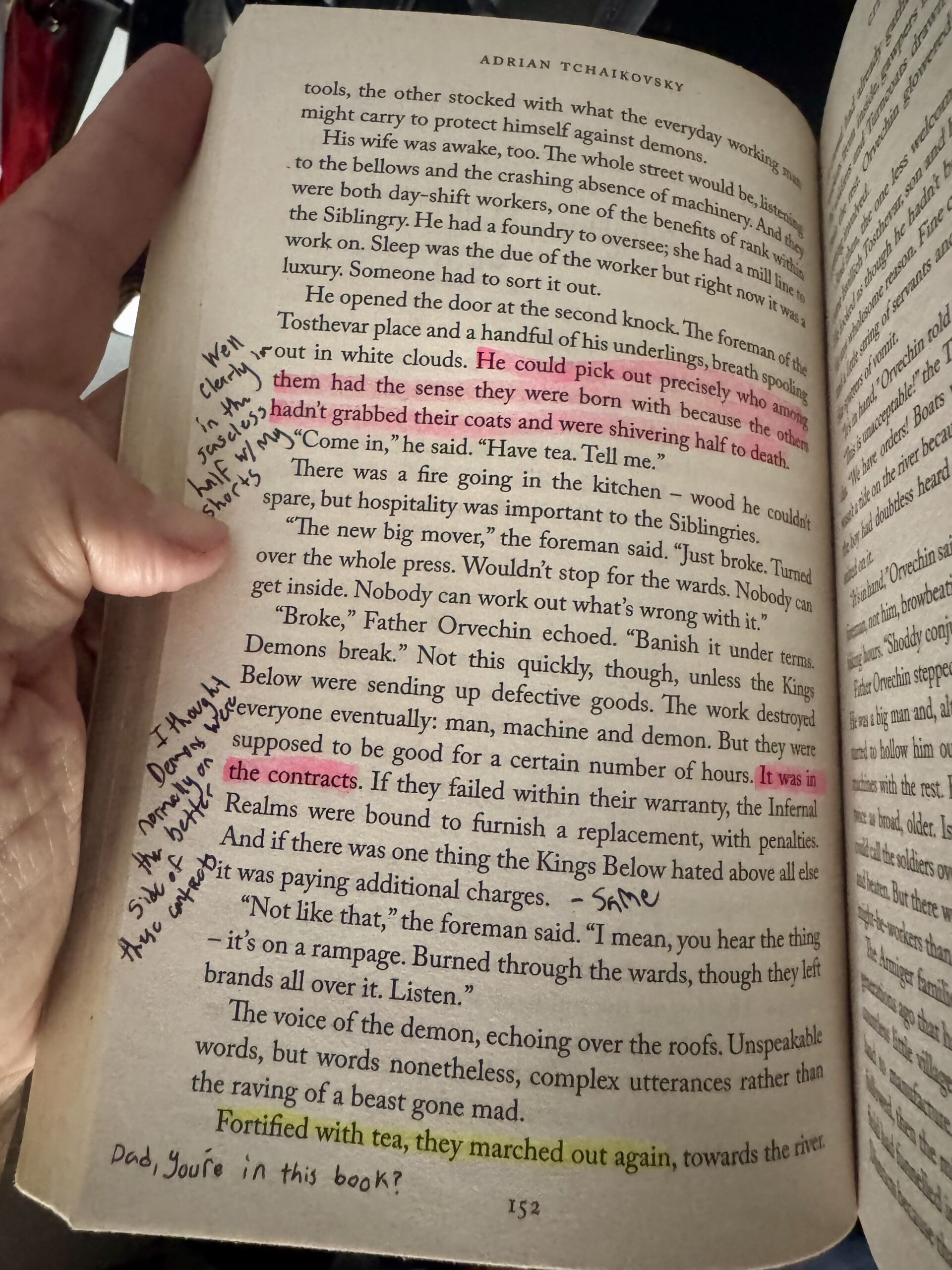
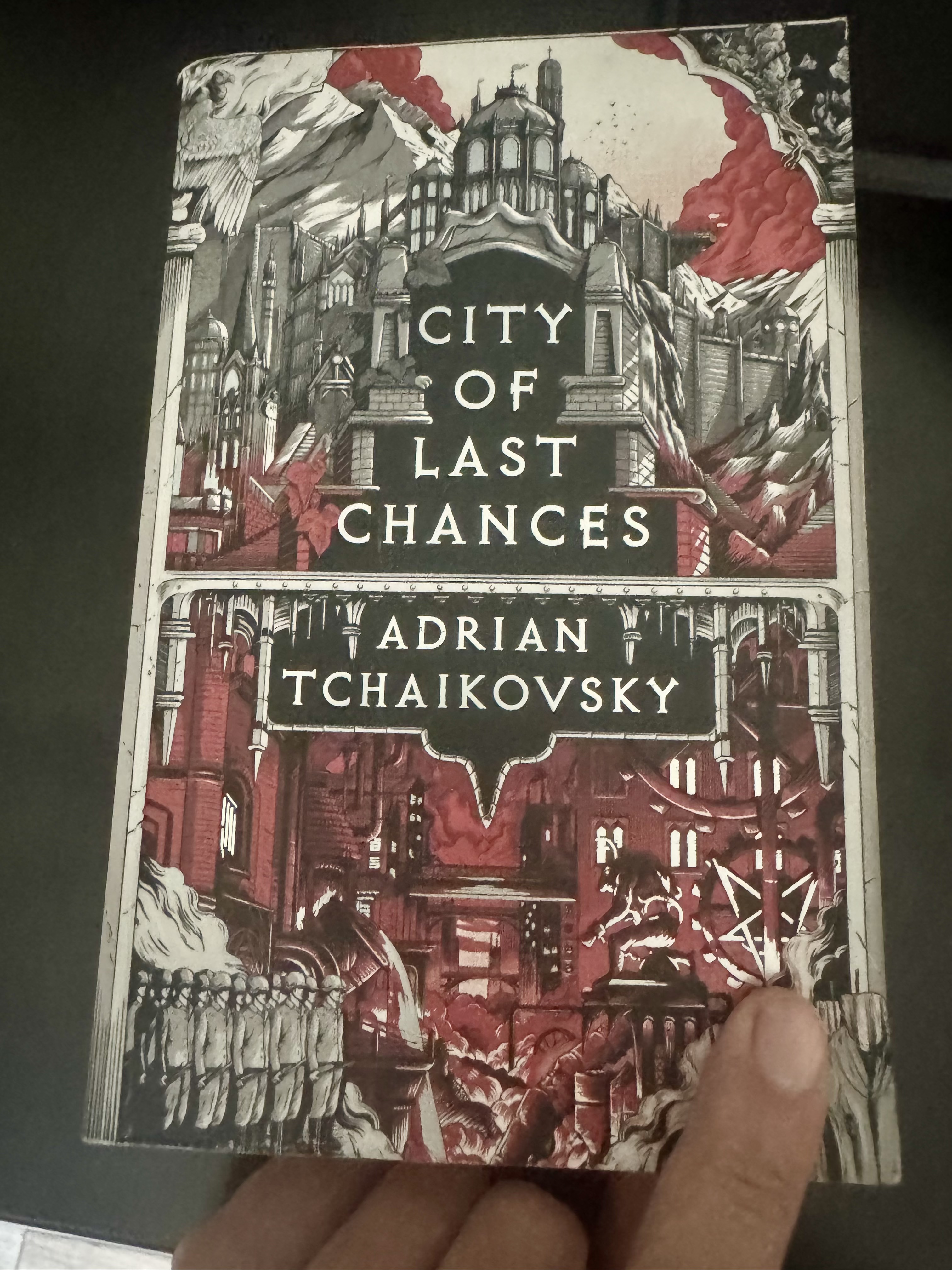
  • City of Last Chances: This is the other book that I loved showing off to others this year. Not because of anything Adrian Tchaikovsky writes in the book — though it was a thoroughly enjoyable yarn — or because it’s a notable edition. The reason I loved this slightly worn paperback is because Maggie and Liam, my youngest kiddos, had read the tale before giving it to me, and had written copious notes in the margins with their own thoughts and reactions to the story, creating a delightful sense as I worked my way through it that I was reading it with them. As reading to the kids at bedtime was one of my great pleasures when they were young, and we’re all now a bit scattered to the wind, this was an absolutely delightful experience, and one that meant a ton to me. (And if you ever want to see me tear up a bit, ask me about the time I left the book at a hostel in San Francisco.)
  • Cloud Cuckoo Land: Anthony Doerr accomplishes a number of impressive feats here: he weaves together five different storylines that don’t seem as though they could possibly intersect, he hangs these stories on an ancient Greek text that doesn’t actually exist, and he manages to evoke sympathy for a young man even as he places a bomb in a library full of children. It’s a remarkable novel that is also remarkably hard to summarize in any meaningful way. Suffice it to say that it has stuck with me, and is one of my favorites of the last several years. A wholeheartedly recommended meditation on the particular value of story.
  • The Dictionary of Lost Words: I bought a copy of Pip Williams’ freshman book for my daughter Maggie immediately after finishing reading it, largely because the heroine reminded me a great deal of her. They share a love of interesting words, a curious nature, a head of extravagantly curly hair, and the particular affection of their fathers. My enjoyment was also augmented by the fact that much of the tale revolves around the creation of the first edition of the Oxford English Dictionary, which I’d read a good deal about in Simon Winchester’s The Professor and the Madman last year. An enjoyable tale that touches on the importance of language, who gets to dictate it, and the roles of women at various times in life and places in society. Quite a debut!
  • I Who Have Never Known Men: I’ll say up front that this novel feels like a narrative cheat to me. It sets up a wonderful central mystery — what happened in Jacqueline Harpman’s post-apocalyptic world? The promise of getting answers pulled me through 80% of the read, at which point I realized (to my considerable annoyance) that answers were not forthcoming. This is a sore point for me with some of JJ Abrams’ and Arthur C. Clarke’s work, so I was particularly disappointed to again not have my questions answered. However, the fact that this was still one of my favorite reads of the year should tell you much about how solid a book it is. And my friend Johanna (who trades in stories herself) suggests that the unanswered questions might actually be constructed to help one empathize with the central character, who is similarly baffled by the state of the world and wants answers as much as we do. This one also had me thinking about it for weeks after I turned the last page.
  • The Ruthless Elimination of Hurry: Going in, I did not know that this was a faith-centered book, nor that John Mark Comer is a pastor; I merely had my brother’s recommendation to go on. While the fact that it is rooted in a Christian understanding of the world will mean it won’t be to everyone’s taste, I found his message identifying the tendency towards overscheduled busyness as an enemy to calm, spiritual depth, and good relationships a compelling one. He makes a good case that silence and solitude, carving out space for rest, and committing to fewer activities would do all of us good. I ended up giving my wife a copy for Christmas, as did my brother. I’m looking forward to us all discussing it together — as soon as we can find time on our calendars!
  • Babel: I will be the first to assert that academic dark fantasy is overrepresented in bookstores these days. Harry Potter launched a thousand literary ships. And I picked this up only because Abigail, daughter , said it was one of her recent favorites. (I didn’t realize at the time that R.F. Kuang, who was responsible for the excellent novel The Poppy War, penned this one as well.) I was quickly and thoroughly won over by the sympathetic and fascinating characters, the nuanced portrayal of both the individuals and the alternate-history Oxford in which it is set, the unique magic system which is of special interest for language enthusiasts, and the author’s readiness to explore all of the fascinating questions of race, empire and its power, slavery, and conflicting loyalties. If you can read this in the context of a book club, where you have a chance to discuss all of the themes with others, by all means do so!

In addition to the books I read in 2025, I have several I’m excited to dig into in 2026: I’ve started Leo Tolstoy’s Calendar of Wisdom, which has short selections centered around a theme to read each day. I’ve had several friends recommend The Will of the Many, and my son’s girlfriend very kindly gave me a copy for Christmas. And, speaking of Tolstoy, my brother and I have been talking about tackling Anna Karenina this year. Finally, after reading C. Thi Nguyen’s Games: Agency as Art in 2024, I’ve preordered The Score, his next work around games and their place in our lives. It’s going to be a fun year!

Parati: Reusable Checklists for People with ADHD (and Everyone Else)

Download Parati for Free (iOS 26 required)

In my life, there are many people for whom I care a great deal who have ADHD.

Its impacts are many: hyper-focus at times, hilarity at other times, “squirrel brain” fairly often, and occasionally difficulty successfully completing tasks that seem like they should be straightforward to those who don’t wrestle with the condition.

There are lots of techniques that people use to manage ADHD. One particularly useful tool is a checklist. Breaking a task down into small components and working through those one by one is a really effective way to keep squirrel brains focused without getting overwhelmed.

As it turns out, checklists are quite useful for everyone else too. My wife is always amazed at how quickly I can pack for a trip. The secret? A checklist — one I’ve developed over years of travel. I’ve also been using checklists to prep for music gigs for years now. (This started on the day that I arrived to play a show with a guitar case that had nothing at all in it.) And I’ve recently begun working through a list when I’m getting ready for bed, which has markedly improved both my home security and my oral hygiene.

I’ve tried quite a variety of apps to help create and work through these checklists that I use over and over: Notes, Google Keep, Obsidian, and more. They’re all useful — but less so than I’d like. Each is designed to solve a wide range of problems, and, as a result, does a dozen things pretty well. But I wanted something that would do this one thing superbly.

So I started building it.

Every time I faced a design decision, I’d think through how I could best meet the needs of my ADHD friends:

  • an uncluttered visual design
  • scheduled notifications to launch a checklist
  • audio and visual cues to provide a sense of progress
  • a gentle reminder to finish a list if you get distracted in the middle of it
  • keeping the phone awake when a list is in progress (but not so long that it kills your battery if you get distracted and walk away)

…and many more details chosen to make the process as enjoyable and friction-free as possible.

In addition, I’ve long appreciated Apple’s dedication to providing amazing tools for accessibility for people with various disabilities. Accordingly, I put a good deal of focus into making the app accessible and useful for people who have vision impairments and rely on Voiceover. I’m proud of this support, and am eager to work with this community to continue making it even better.

After a couple months of evenings and weekends work, Parati went live in the app store yesterday. If you use an iPhone and have upgraded to iOS 26, I would love to get your thoughts on it, especially if you have ADHD or use Voiceover. I’m making it available for free in hopes that it will find a place on your phone and make your life easier. If there’s anything you’d like to see added, please add it to the feature request board.

The name, by the way, is a bit of a double entendre. (But not the dirty kind. (Well, unless you know something I don’t.)) It’s pronounced “Parity,” which points to the effort that I’ve put into making it useful for people with ADHD and visual impairments. But it also references the Spanish phrase that means “for you” — “para tí” — a reflection of the fact that I hope it will feel personalized and delightful for each of you who uses it.

A Delightful Birthday Gift

A delightful birthday gift I received this year: a copy of a book from my “to read” list that my zookeeper daughter and programmer son read before me, leaving highlights and annotations for me to enjoy along with the main tale. (I had recently enthused with them about how much fun I was having with J.J. Abrams & Doug Dorst’s “S”, which tells its story in a similar way.)

I just love this.

My Favorite Reads of 2024

As is my wont, I read a fair bit in 2024. Here are the books I tackled this year that I found most interesting, challenging, engaging, and/or compelling:

(Note: I get a bit of a commission if you buy any of these books through my links.)

  • Designing Games: I was keen to read this based on the topic alone, and even more when I realized it was penned by Tynan Sylvester, the designer behind Rimworld (the computer game which has consumed more hours of my adult life than any other). It did not disappoint. It engagingly and systematically walks through all of the considerations and pitfalls involved in creating a video game. To my surprise, however, this was also the best book on management I read this year, with a trove of insights on shepherding and motivating people. I’ll definitely be applying lessons from this book to my own management practice.
  • In Cold Blood: My son read this in high school and recommended it to me then. It took me 10 years to get to it (sorry, boyo!) but I’m glad I finally did. In addition to simply being a gripping tale, it also presaged a couple of literary movements: the rise of true crime stories — perhaps most common in podcasts and documentaries currently — and historical accounts told narratively, with a combination of the writer’s extensive research and informed imagination creating a vivid account of events. (Erik Larson is one of my favorite contemporary authors doing this sort of writing.)
  • The Dark Forest & Death’s End: books 2 and 3 in Cixin Liu’s celebrated Remembrance of Earth’s Past series. Caveats: I found the reading itself less enjoyable than with many of my favorite books. The characters feel somewhat wooden, the translation from Chinese reads a bit stilted, and the foreshadowing is at times so heavy I was left wishing my audiobook app had a “skip to where the other shoe drops” button. But oh boy, for sheer number of interesting ideas woven into a compelling narrative and for epic scope, I can’t think of anything to beat it. 
  • Educated: my son’s girlfriend recommended this autobiographical account of a young woman’s emergence from a very sheltered religious upbringing into the wider world of people and ideas. Westover’s luminous prose, the harrowing accounts of the abuse and neglect she navigated, and her compulsion to understand herself and the compelling beauty she finds in the arts make this a riveting read, front to back.
  • Piranisi: I discovered Susanna Clarke’s first book, Jonathan Strange and Mr. Norrell, entirely by accident in a bargain bin some years back. It was rich and wonderful, and I was eager for more from the freshman author. Unfortunately, health challenges have kept her from publishing very often, but Piranisi was a delight that turns, by book’s end, into an entirely different delight. Recommended for fans of mystery or the fantastic. (Note: I just now learned the origin of the protagonist’s name. Further wonders!)
  • White Too Long: the first church I attended willingly, rather than under duress from my parents, was Trinity, a Southern Baptist Church in San Antonio. I was shocked and dismayed to learn early in this book that the Southern Baptist denomination had its 19th century roots in the pro-slavery movement. From there, the book traces the history of white nationalism in the US. It was a good history lesson for me as well as providing some excellent insight into the current state of the nation. (This book was also notable to me because I picked it up at Ebenezer Baptist Church, where Dr. Martin Luther King used to preach.)
  • The Everything War: a history of Amazon, from its scrappy founding, to the wake of would-be partners that have had their ideas and products appropriated, to the difficult conditions under which company employees labor. This was a revelatory read, and has given me plenty of motivation to buy things from other vendors whenever possible. (Balance this, however, with the fact that I loved touring one of their distribution centers a few years back and seeing human and machine working together in an intricate dance of logistics.)
  • Surrender: As a long-time fan of U2, I was keen to grab a copy of Bono’s book as soon as it came out. It took me a good spell to read through it all because of its rich, poetic, episodic nature — reading a single story was delightful and left me satisfied for a week or two before I’d want to go back for another. The Irish love of storytelling comes through strongly, and it’s fascinating to get to better know Paul Hewson, his loves, his family, his thoughts on art, and his reflections on getting into an on-stage fistfight in the early days of the band.
  • Let Your Life Speak: My brother recommended this short book to me a few years back, and when I finally got to reading it, I was annoyed that I hadn’t gotten around to it sooner. It’s a stirring and honest exploration of one’s calling in life, and affirms the idea that we’ll be most fulfilled when we’re working with the fabric of our innate natures rather than fighting against it. I also very much appreciated, enjoyed, and occasionally burst into laughter at Palmer’s account of his experiences with Quaker spiritual practices.
  • Games: Agency as Art: As an enthusiastic player (and occasional designer) of both computer and board games, I sometimes feel a little bit defensive of the hobby. This book provides an excellent exploration of the unique value of the medium as a conveyor and creator of experiences, and puts into clear words many ideas I’d had lurking in the recesses of my mind (as well as providing a wealth of new ones). If you feel that games have value and want to be able to articulate what that value is, find a copy of the English translation and dig in!
  • After On: AI has been much on my mind the last couple of years. I’ve been using LLMs in both my programming practice and personal life, as well as building AI-based products at work. Last year’s reading of Human Compatible gave me some good grist for the brainmill on how to keep runaway AI from turning us all into paperclips. This novel provides a very entertaining alternative vision for how a human-aligned AGI might come about (and nearly doesn’t). The plot threads do eventually all come together, I promise!
  • Stories of Your Life and Others: For sheer pleasure per word, Ted Chiang’s short story collection topped my reading list this year. From his reimagining of the Tower of Babel tale, to Story of Your Life, the linguist’s reminisce that was the inspiration for Denis Villeneuve’s movie Arrival, to Liking What You See, a fascinating gendankenexperiment on how society would change if we didn’t see human beauty, there was so much to savor in this collection that I’ve spent the rest of the year recommending it to anyone who would listen.
  • A City on Mars: I have quite complicated feelings about Elon Musk. But I don’t know of anyone better at starting from first principles and taking the necessary steps to move toward a goal. His compelling vision that humanity should be a multiplanetary species has driven his successes at SpaceX, Tesla, and Starlink, and has been amazing to see put into action. When the Wienersmiths announced their exhaustively researched (and liberally cartooned) examination of the challenges of humanity setting up shop on the nearest likely planetary neighbor, I preordered immediately. Simultaneously scholarly and full of delightful off-color jokes, it’s a must-read for anyone with an interest in the subject matter.
  • The Perfectionists: This was the first book by Simon Winchester that I’d read, and I was so taken with it that I followed up with Krakatoa and The Professor and the Madman later in the year. This far-ranging history of precision engineering, from the challenges of building cannons and steam engines precisely enough to not leak or blow up, to the staggeringly sensitive gravity observatories that detect subtle distortions in spacetime and are arguably the most precision-engineered artifacts ever created, is engaging throughout. Hearing it in Winchester’s delightful English accent is a bonus of the audiobook version.

What a rewarding year in the stacks! I’d love to know what your favorites have been, as I’m always eager to hear what ideas, tales, and provocations have engaged my friends, and constantly looking for good recommendations. Please drop me a note!

Christmas Update 2024

Howdy friends, near and far, young and old, those who we haven’t seen this year and those who may feel they’ve seen too much of us,

As I write this update, I’m still optimistic that it will get printed, signed, into an envelope, and finally to you before December 25 rolls around. This feels a bit of an extraordinary hope, given both our last few years’ experience around the holidays and how full these twelve months have felt. (There are, however, still ample opportunities for things to go pear-sideways before our plans bear fruit, so here’s hoping…)

Kris has continued to do great work at St. Luke’s Episcopal Church, where she serves as the Director of Children and Family Ministries. In addition to the Christmas pageant she’s currently bringing together, some other high points have included: starting a women’s book study, assembling the strongest staff of Sunday School volunteers she’s had yet, putting together several family art nights, planning joint activities with the school, and starting an after-church tradition of families meeting up on the playground after services. On the home front, she’s launched a “Block Connector” initiative under the umbrella of our Neighborhood Association, which has helped equip over 50 volunteers to get to know their neighbors and to start phone trees to keep in touch and help one another as needs arise. Finally, she’s been working hard to take good care of herself, making regular trips to the YMCA gym, starting allergy shots, and continuing to cook creative, healthy, and delicious meals for us and for friends.

Sean has continued at Doximity, where he’s currently building AI tools for doctors and managing a few team members. The band he plays with, The Happy Out, has gained momentum, adding several additional shows and festivals to their regular fortnightly appearances at our local pub. The lads attended O’Flahertys Irish Music Retreat together back in October, and were all quite inspired by 16 hours a day of Irish music over the course of a long weekend; we definitely hope to return! He is also enjoying a couple of monthly board game nights with his brother Chris and some nearby friends, continuing to read a lot, hiking when he can squeeze it in, learning more about audio engineering and production, and also hitting the (home) gym with some regularity. 

Our shared travel this year has included a marriage retreat in Canyon Lake, our annual trip to Indianapolis to visit with Kris’ family, a San Diego visit to visit with Savannah and her beau, a run up to Dallas for Kris’ work and a visit with Liam, a birthday camping weekend at Guadalupe River State Park, and a delightful vacation near Austin with the kids. Kris got the chance to go spend a few days solo with her sister Kim in Seattle. Sean visited San Francisco, Denver, Toronto, and San Diego for work, and made it up to Durango for a special trip with his mom. After all of that, it feels great to just be home for Thanksgiving and Christmas this year!

We continue to enjoy and be terribly proud of our young people. Maggie is still providing top-notch care for many of the large mammals at the zoo (Rhinos and Capybaras are particular favorites) and is gardening up a storm at her home. Liam is still in N. Texas, and has switched jobs this year to work for Henry, a company providing medications to folks in need through the mail. He’s enjoying time with his delightful long-time sweetheart Tea (who reliably provides us with superb reading and travel recommendations), and has taken up riding a Onewheel. Abigail continues working as a Surgical Technician, winding down her job in San Antonio as she and Christian make plans to move to Bentonville, Arkansas. (Christian has started managing a program for Walmart to keep medication prices affordable for all.) We’re sorry to lose them in Texas for at least a few years, but are excited for their new adventures up there (and look forward to taking advantage of their guest room). Emily, Xander, and Juniper remain in San Marcos. Xander enjoys being the graphic designer for the city of Kyle by day, and hosts D&D games and plays guitar by night. Emily pours out her creative energy in the home. Much like the characters of Juniper’s favorite show “Bluey” come to life, they are an inspiring family to behold. Juniper loves bugs, slugs, and anything out in nature. We love being her “Granfer” and “Grandma Kris”! Savannah is out in San Diego doing good work managing a Better Buzz coffee and enjoying the west coast life.

We still love San Antonio, and make the most of the opportunities to spend time with all the different portions of our family who are here in town. Our neighborhood has continued to get more lively: good friends of ours are opening a wine shop, and several “third place” cafes and hangouts continue to attract more of our neighbors. The city’s culture benefits from so many interesting historical streams, and we love hearing Spanish around town almost as frequently as English. Our guest room is filled less often than we’d enjoy, so come stay with us, and enjoy what Mark Twain considered one of only four unique cities in the US!

We do hope this finds you well; if you are receiving this, know that we value your friendship and think of you fondly! May you enjoy every blessing you can think of (and some that surprise you), and may our paths cross soon!

Grace, peace, and joy to you,

Sean & Kris

Optimizing SFSymbols with SVGO

Back in 2019, Apple introduced SFSymbols: a rich set of glyphs in a common style designed for developers to use in their apps. At the same time, they added the ability for developers to create their own custom symbols that would get all of the same useful behaviors as those provided by Apple. These custom symbols are defined in SVG files.

SVG is a rich format, and often includes more data than is necessary just to render an image. SVGO is currently one of the most widely-used tools for optimizing SVG files by stripping out unnecessary information. Its default configuration does a great job of making SVG files substantially smaller while still ensuring that they render correctly.

Unfortunately, using this default configuration on the SVG files used to define an SFSymbol removes the non-rendering information that Xcode relies on to create that symbol. By turning off a few of the default optimizations that SVGO provides, however, one can still use it successfully to optimize all of the SVG files in an Xcode project. (This includes both those you’re using for custom symbols and any used as regular images.) Here’s the necessary configuration to get it to work correctly:

export default {
    plugins: [
      {
        name: 'preset-default',
        params: {
          overrides: {
            // disable a default plugin
            collapseGroups: false,
            cleanupIds: false
          },
        },
      },
    ],
  };
  

If you save that to svgo-config.mjs, you can then optimize all the SVGs in your Xcode project by running svgo --multipass --config svgo-config.mjs -rf . in your project’s root directory.

Integrating WordPress and Mastodon using ActivityPub

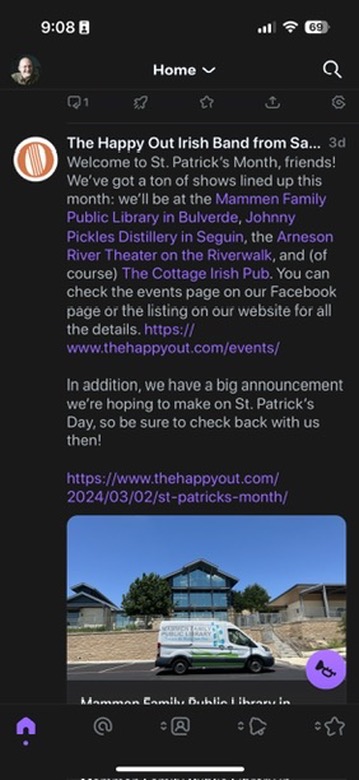
Last year, Automattic (which runs WordPress.com) acquired an ActivityPub plugin for the WordPress CMS/blogging platform. This caught my eye, as Elon’s sabotage of Twitter was continuing apace, finally giving me impetus to switch over to Mastodon and explore it and the other services that interoperate with it through the ActivityPub protocol.

I installed the plugin on a couple of websites I run, and have been delighted to discover several interesting things:

  • ActivityPub makes a better-than-RSS replacement for RSS. Since ActivityPub is a bidirectional protocol, using it to keep up on websites allows commenters to interact with your site without having to visit.
  • The ActivityPub plugin runs quietly alongside your other syndication methods, and doesn’t require any additional care and feeding once it’s set up.
  • The plugin can also publish content types other than weblog posts. I use an event calendar plugin on one of the sites where I use ActivityPub, and have that site configured so that each of those also is published as an ActivityPub item when I post it.
  • The plugin works great out of the box with Mastodon. I haven’t tried it with other ActivityPub clients, but it seems to have enough flexibility around how articles are published to ensure that one could get it working smoothly without much fuss, and has explicit support for many other clients.

Setting Up and Using It

I’ll use my band’s website, www.thehappyout.com, as an example. Here’s what I did:

  • Installed and configure the ActivityPub plugin on my WordPress site.
  • Using my personal Mastodon account, searched for profile @news@www.thehappyout.com and followed it. (Thanks to WebFinger support, searching for www.thehappyout.com also works.)
  • Posts on the website now appear in my Mastodon feed.
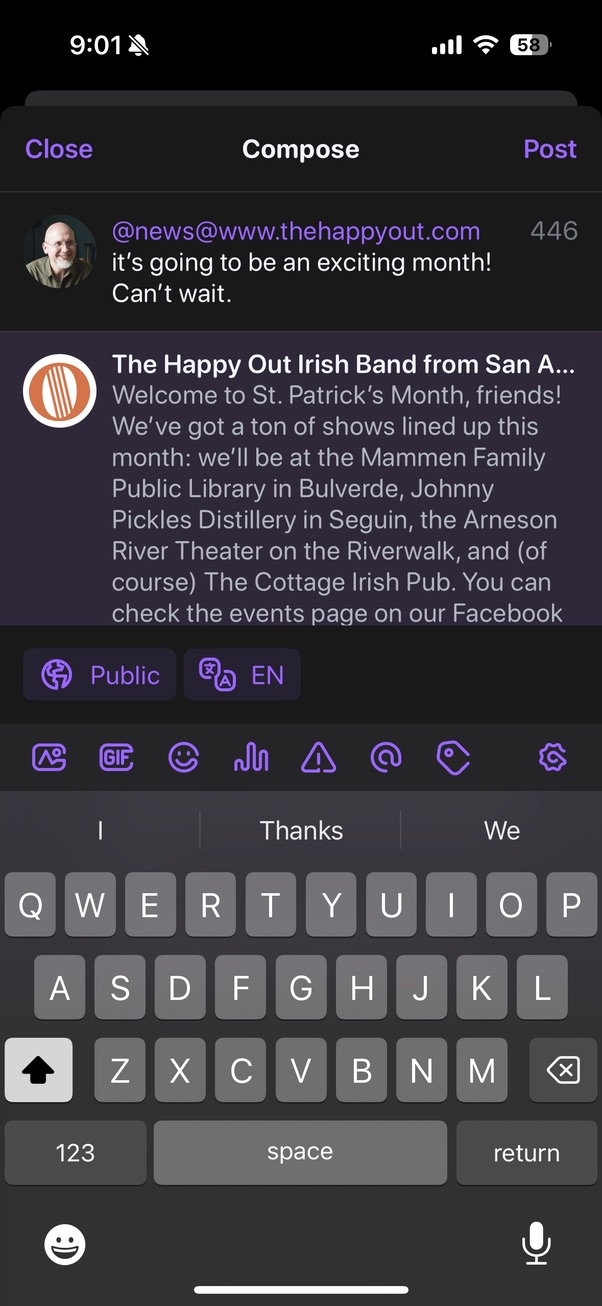
  • I can now reply to these posts, just as I would to one that had originated in Mastodon.
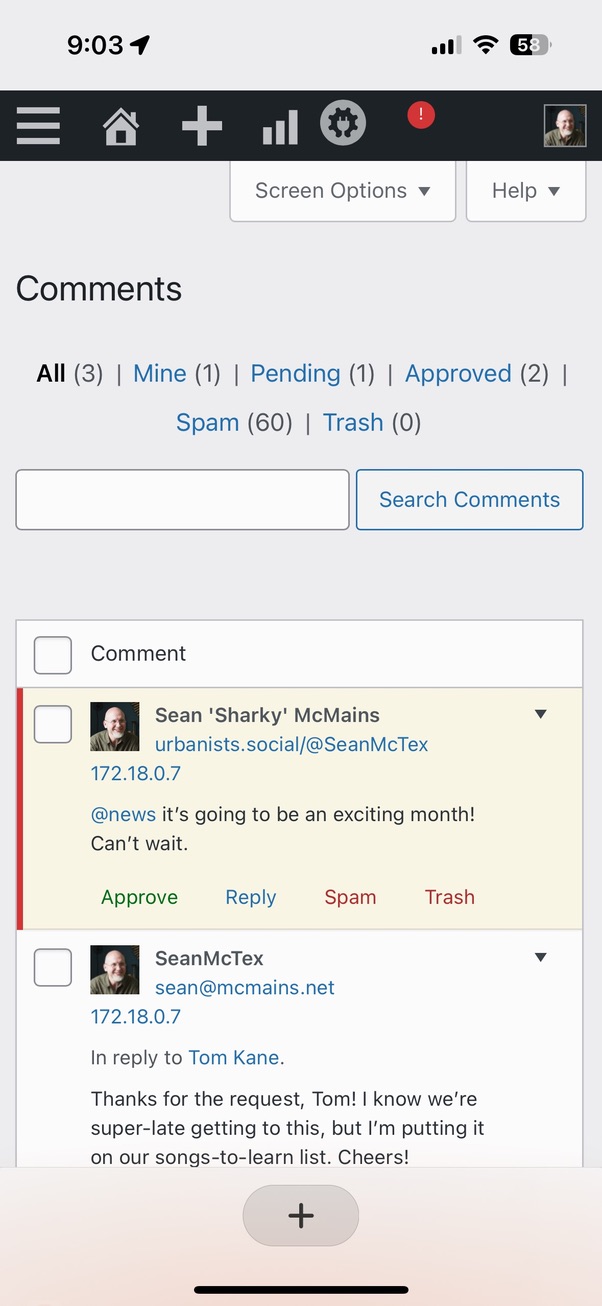
  • These replies go through the normal WordPress moderation channels and appear on the website just like any comments would that originated on the site itself.

It’s great to see all of this interoperating so smoothly at this point. Big props to Matthias Pfefferle & Automattic for their investment here!

Open Issues

  • It’s common to link to social media sites with a bunch of icons. I can do that to a Mastodon profile, but haven’t figured out a good way to do so with this approach.
  • When an event is published through this mechanism, the time/date and location are not included in the ActivityPub item. If there’s a way to include this sort of metadata in one’s published feed, I haven’t yet figured it out.
  • How do authors who rely on advertising on-site manage monetization if readers don’t have to visit the site? (This was a question for RSS as well, and I suspect the answers will be similar: include ads in the feed itself, or only include excerpts in the feed so readers are still encouraged to visit the site proper.)

On Games as the Art of Experiences

John Dewey suggested that many of the arts are crystallizations of ordinary human experience. Fiction is the crystallization of telling people about what happened; visual arts are the crystallization of looking around and seeing; music is the crystallization of listening. Games, I claim, are the crystallization of practicality…Fixing a broken car engine, figuring out a math proof, managing a corporation, even getting into a bar fight—each can have its own particular interest and beauty. These include the satisfaction of finding an elegant solution to an administrative problem, of dodging perfectly around an unexpected obstacle. These experiences are wonderful—but in the wild, they are far too rare. Games can concentrate those experiences. When we design games, we can sculpt the shape of the activity to make beautiful action more likely. And games can intensify and refine those aesthetic qualities, just as a painting can intensify and refine the aesthetic qualities we find in the natural sights and sounds of the world.

-Thi Nguyen (Games: Agency as Art)

2023 Holiday Update

Dear Friends,

As the dust settles from this year’s madcap Christmas celebrations, it’s time for us to look back on 2023 and share its high points with all of you with whom we don’t get to spend as much time as we’d like!

Kris invested much time and creative energy at St. Luke’s Episcopal Church, where she continues to serve as the Director of Children and Family Ministries. She has organized and coordinated all manner of classes and events, and goes to great lengths to shepherd new families into the community there. Of particular note was the Christmas Pageant, which is based on the French carol “The Friendly Beasts” and which features a wide swath of fauna that visit the holy child in the manger. In addition, by dint of hard work, exercise, and the help of a good PT team, Kris’ ribs have now largely healed from fractures sustained on a trip to a nearby waterpark. We’re very glad to have her once again firing on all cylinders!

Sean continues working on software to help doctors and manages a few folks at Doximity. He’s been playing with The Happy Out, an Irish pub band, for a year and a half now, and has delighted in seeing the band’s regular shows at The Cottage (our new favorite restaurant bar) become a meeting place for family and friends. He’s enjoyed a ton of reading this year (though the “to-read” list somehow always grows faster than the “finished” list), and is also getting close to finishing up a board game he’s been designing (with some excellent input from his monthly gaming group). Current topics of study include AI, game design, urban infrastructure and transit, audio engineering, the feasibility of space colonies, and beekeeping. (Nerd!)

We’ve been grateful for the opportunity to do some traveling this year: a marriage retreat to Galveston, a trip to Indianapolis to visit Kris’ family, a Texas coast romp with Sean’s kids, and a little overnight getaway to Fredericksburg. Kris has also gotten to know more of the Texas Hill country, embarking on several delightful day trips with girlfriends, and we’ve enjoyed several wonderful visits from various friends and family. (Come visit! We love guests and playing tour guide.)

Our progeny are doing well: Emily & Xander are still in San Marcos, fully occupied raising Juniper, our adorable granddaughter. Abi finished up her schooling and launched into her Surgical Technician career in downtown San Antonio, where she’s doing a bang-up job. Savannah is out in San Diego, enjoying her work managing a coffee shop and often providing us excellent reading suggestions. Liam works at a software agency in Dallas, where he’s advanced into increasingly responsible technical leadership roles. Maggie continues to work with her beloved animals at the SA Zoo and bought her first house, leaving us with an empty nest. (That took some getting used to!) We are grateful to see them all continuing to become kind, responsible, frequently hilarious adults, and we treasure the time we get with them.

We continue to revel in our Beacon Hill neighborhood, its mix of Spanish and English speakers, the coffee shops, taquerias, restaurants, and antique stores within an easy stroll, the monthly neighborhood happy hours, the community garden, and all of the creative, artistic, and musical friends we’ve found here. What a joy it is to be in such a lively place and close to our San Antonio family! Kris has found homes for several of the feral cats that we had adopted, leaving us with only three in the backyard currently. (They are, however, often joined by raccoons, possums, and skunks — our unofficial neighborhood mascot.)

We are grateful for your friendship — that precious currency in which we count ourselves remarkably rich. As we look forward to 2024, we wish you every blessing, and hope we’ll have an opportunity to spend time with you.

Peace and all good things,

Kris and Sean

Beagle at the Bar

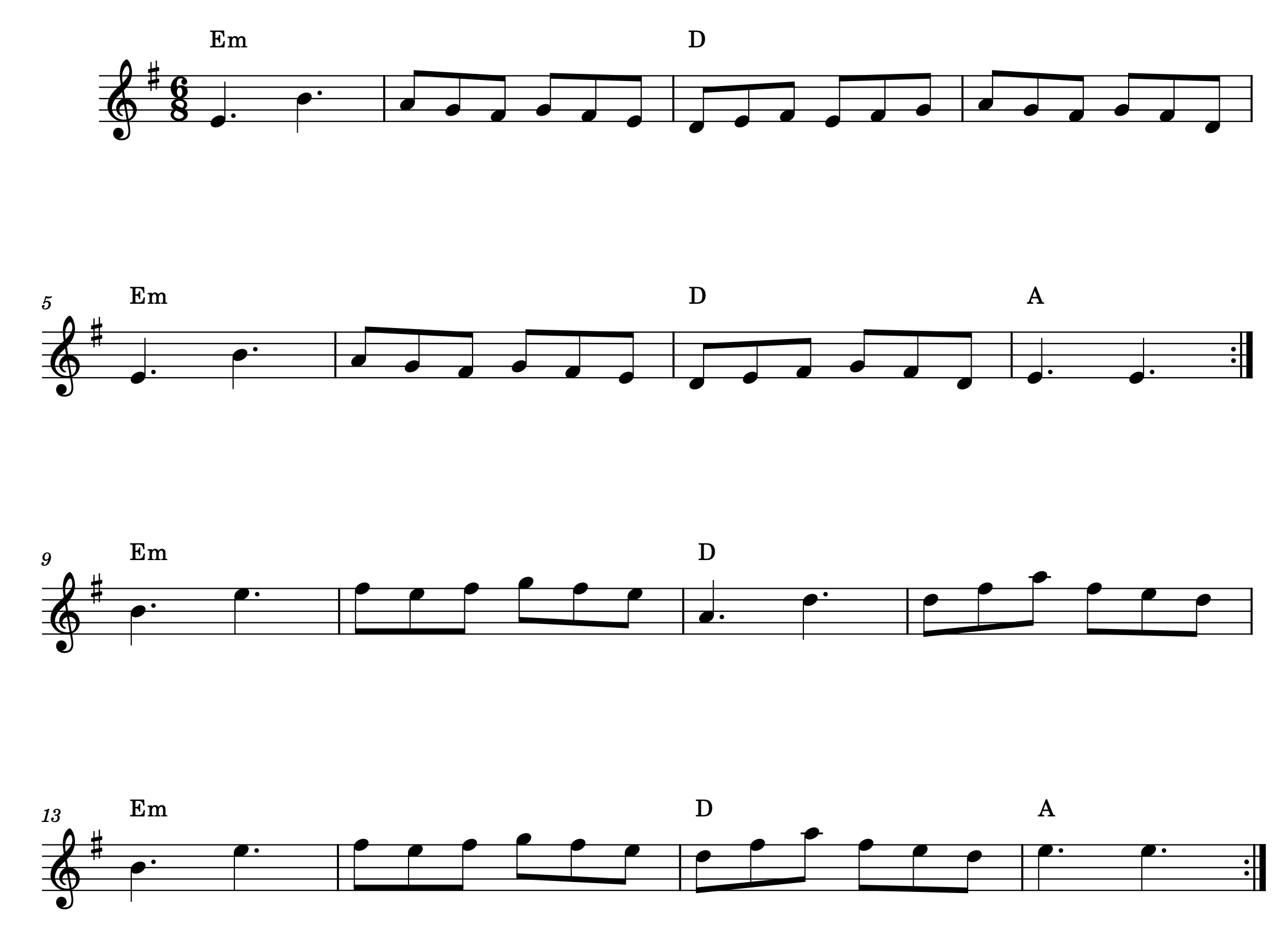
Some years ago, I wrote a little jig. During a rehearsal last night, we decided to incorporate it into The Happy Out’s version of “All for me Grog”. As I needed to later communicate it to our fiddle player, I finally got around to writing it out and giving it a title inspired by an experience my wife and I had wandering through the streets of Cong on our honeymoon: “Beagle at the Bar”.

"Beagle at the Bar" melody and chords

PDF Download